A while back I spent a morning at a distribution centre. It was a well-run operation, with a good team and serious investment in warehouse technology. Even so, I watched a fully loaded trailer sit at the dock for the better part of an hour while a member of staff worked through the inbound count by hand, chased an ETA that had already been phoned through twice that morning and waited for the system to confirm what had just been physically unloaded.
Nobody there thought this was strange, because to them it was simply business as usual.
That is exactly what makes manual processes around load carriers so expensive. The cost no longer feels like a cost, because it has become standard practiceand because it is normal, nobody sits down to count what it actually adds up to. When you do, the total turns out to be larger than most people expect and it shows up in far more places than the loading dock.
The labour cost hidden in every inbound trailer
Processing an inbound trailer involves a series of steps: confirming the ETA, assigning a dock, unloading, scanning and checking and signing off the paperwork. Unloading is physical work. Much of the rest is about establishing what is arriving, when it is arriving and whether it matches what was expected and in most DCs that information is still gathered by hand, by phone and by re-checking what other parties already know.
Each of those steps may only take a few minutes, so on a single trailer the time lost hardly seems worth discussing. The picture changes when you multiply it by every trailer, every day, across every depot in the network. At that scale, a few minutes per trailer becomes a structural labour cost, at a time when labour shortages at DC level make every manual hour harder to fill and tight margins leave little room for inefficiency.
That is before you add the costs further down the line, such as the time spent resolving delivery disputes, the administrative burden of manual proof of delivery, investigations into missing roll cages and transport planning that cannot rely on knowing how many empty load carriers are actually available to move.
Why loading errors at the DC become disputes at the store
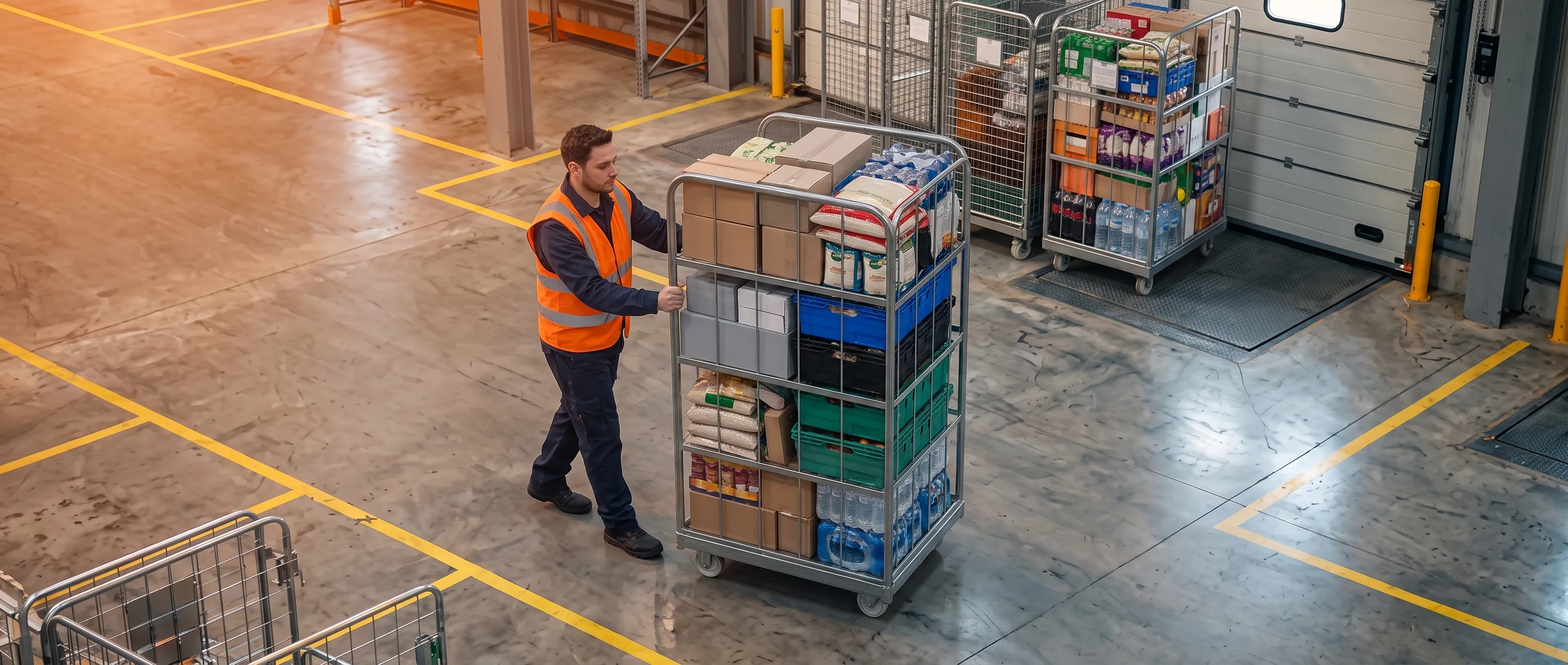
Alongside inbound, there is a related pain point that does not get enough attention: the loading dock itself. In most operations, loading a trailer for store delivery still involves manual scanning, roll cage by roll cage and pallet by pallet, to confirm what is going onto the vehicle. It is slow and prone to error and when it goes wrong, the consequences are felt at the other end. A roll cage loaded in error, or missed entirely, leads to a mismatch at the store, a disputed delivery and an investigation that nobody has time for.
The alternative already exists, because load carriers can be registered automatically as they pass through a loading door, without anyone scanning them. In my experience, many networks have not yet taken that step, either because the integration seemed too complex or because the problem has been absorbed into daily operations in the same way manual inbound has. The operational case is straightforward, since fewer errors at despatch mean fewer disputes at delivery and fewer disputes mean less management time spent on investigations that add no value to anyone.
What a missing roll cage really costs a retail network
Roll cage loss sits in the background of almost every retail DC operation. When a roll cage goes missing, a search begins in the form of emails, phone calls and manual checks at several sites and the roll cage either turns up or gets written off while spare stock keeps operations running in the meantime.
The instinct is to treat this as a replacement problem, on the logic that if you lose enough roll cages, you simply buy more. The replacement cost, however, is usually a small and already budgeted line item. The real cost lies in the investigation itself, the management time, the friction with suppliers and the ongoing uncertainty about whether the pool is the right size.
Dwell time makes this worse, because roll cages that stay at stores longer than necessary mean more of them are in circulation than the network actually needs. That is capital tied up in load carriers that are not moving. Since nobody knows for certain where they all are, the default response is to order more rather than to optimise, which ties up even more capital without solving the underlying problem. Many networks end up carrying a bigger pool than they need for one simple reason, which is that they do not trust their own numbers.
How load carrier availability affects on-shelf availability
So far I have described all of this as a cost problem, but there is another dimension that matters more to some parts of the organisation than any labour saving. When load carriers are delayed, whether they are standing idle at a store, slow to return from the network or held up in a disputed delivery, the products they are meant to carry do not reach the shelf on time. In retail, that means an out-of-stock and those lost sales do not come back.
The link between load carrier flow and on-shelf availability is rarely modelled explicitly, because the two are managed separately. DC operations own the roll cages while the commercial side owns availability, so the cost of slow rotation falls between them. In my experience, when you trace a persistent out-of-stock back to its root cause, load carrier availability and dwell time appear in the chain more often than people expect. Faster rotation, based on knowing where your roll cages are and how long they stay there, makes faster replenishment possible and helps keep more product on the shelf.
Why knowledge of load carriers gets lost at handovers
Three things make this harder to fix than it looks.
The first is the handover. A roll cage can be well registered inside your own DC, yet once it leaves with a haulier and arrives at a store, nobody may log it at all. Handovers are where knowledge gets lost and they cross several organisations, each with its own systems and its own incentives. Any approach that stops at the boundaries of one organisation leaves exactly those moments out of view.
The second is adoption on the work floor. Any solution that asks DC teams to do something extra, such as an additional scan or another step in the process, will erode under operational pressure. The approaches that hold up at scale capture data automatically, without adding to the workload of teams that are already stretched.
The third is ownership. DC operations, transport, procurement and store operations each feel a different part of the problem, but none of them owns the full picture. That makes it difficult to build an internal case, because the costs are spread across functions even though the root cause is the same.
What changes when knowledge of your load carriers builds
When load carriers are registered automatically at the points that matter, such as loading docks, DCs and stores, the knowledge you gain starts to change daily operations in several ways.
Inbound becomes predictable
Deliveries can be confirmed electronically instead of manually and more accurate ETAs make slot planning easier and loading and unloading faster. Scanning turns from a process of discovery into a process of confirmation.
Disputes get shorter
A digital record of what was loaded and delivered, linked to the actual load carriers, means disagreements are resolved against registered movements rather than two versions of the truth. Loading errors can be flagged before a trailer leaves the building and proof of delivery no longer depends on paperwork.
Pool decisions rest on facts
Knowing how many roll cages you have and where they are lets you balance the pool across DCs and stores, reduce dwell time and plan the size of your pool on facts instead of estimates, rather than buying more to cover for uncertainty.
Shelves are replenished more reliably
This does not happen overnight, but faster rotation supports more reliable replenishment and the effect on shelf availability becomes visible in the data once you can see more of the picture.
None of this replaces the systems your teams already use. CLC enriches your WMS, TMS or ERP with verified location and movement data, so the decisions made in those systems rest on better information. It also does not have to start with a large transformation programme.
Starting small with one DC and one roll cage flow
The organisations I have seen make real progress usually start small, with one DC, one flow and one specific pain point where the cost is measurable and the improvement can be demonstrated. That might be roll cages moving between a DC and a group of stores, or the inbound process at a single site. From there, the knowledge you build shows where the next value lies, so you can decide on facts what to connect next.
Over time, that picture can grow beyond your own operation. Producers and transport companies depend on the same load carriers and when they connect and you agree to share data, handovers become clearer because everyone works from the same facts. Each organisation stays in control of what it shares and with whom.
The question that tends to open the conversation is a simple one: what would it mean operationally if you knew how many roll cages were in this yard and where your inbound trailers were in the chain? Usually, the answer is clear enough to justify finding out.
Running your network on facts instead of hope
Knowing more about your load carriers is not about seeing more dots on a map. It is about knowing what your operation is capable of when it is no longer slowed down by its own load carriers. So I would like to leave you with one question: are you running your network on what is actually happening, or on what you hope is happening?
For more than 30 years, Carl McInerney has worked across complex retail and FMCG supply chains, including networks linked to Tesco and Coca-Cola. Today, as Regional Commercial Director GB & Ireland at CLC, he focuses on operational continuity across retail and logistics networks.